February 4, 1863
Another boring day with no fighting. It's been snowing for two days. More and more people are joining the military now. If what I have heard was correct, now one half of the men in the Union, and 4/5 in the Confederacy, have started their service in the military. In the camps, there are many young soldiers who have never left their families for so long in their lives. Many of them are always homesick, and they keep writing letters to their families and friends or spend their spare time practicing religion. These are good ways to escape from reality for a while -- I sometimes do the same to free myself from all the coming dangers.
The living conditions in the camps are not very good, either. We often encounter shortages of food and other supplies, because the Union have been operating blockages on water routes. In the past two years, we were able to overcome these blockages by using blockade runners, but it seems like the blockade runners are not as effective any more. The lack of a navy has definitely cost us a huge loss.

Photo of Blockade Runner
Besides, due to the bad conditions, many soldiers have fallen ill. Thousands of us have died because of disease and malnutrition. In prison camps, the situation is even worse. I have witnessed a prison camp in Andersonville. It is overcrowded with more than 30,000 people.
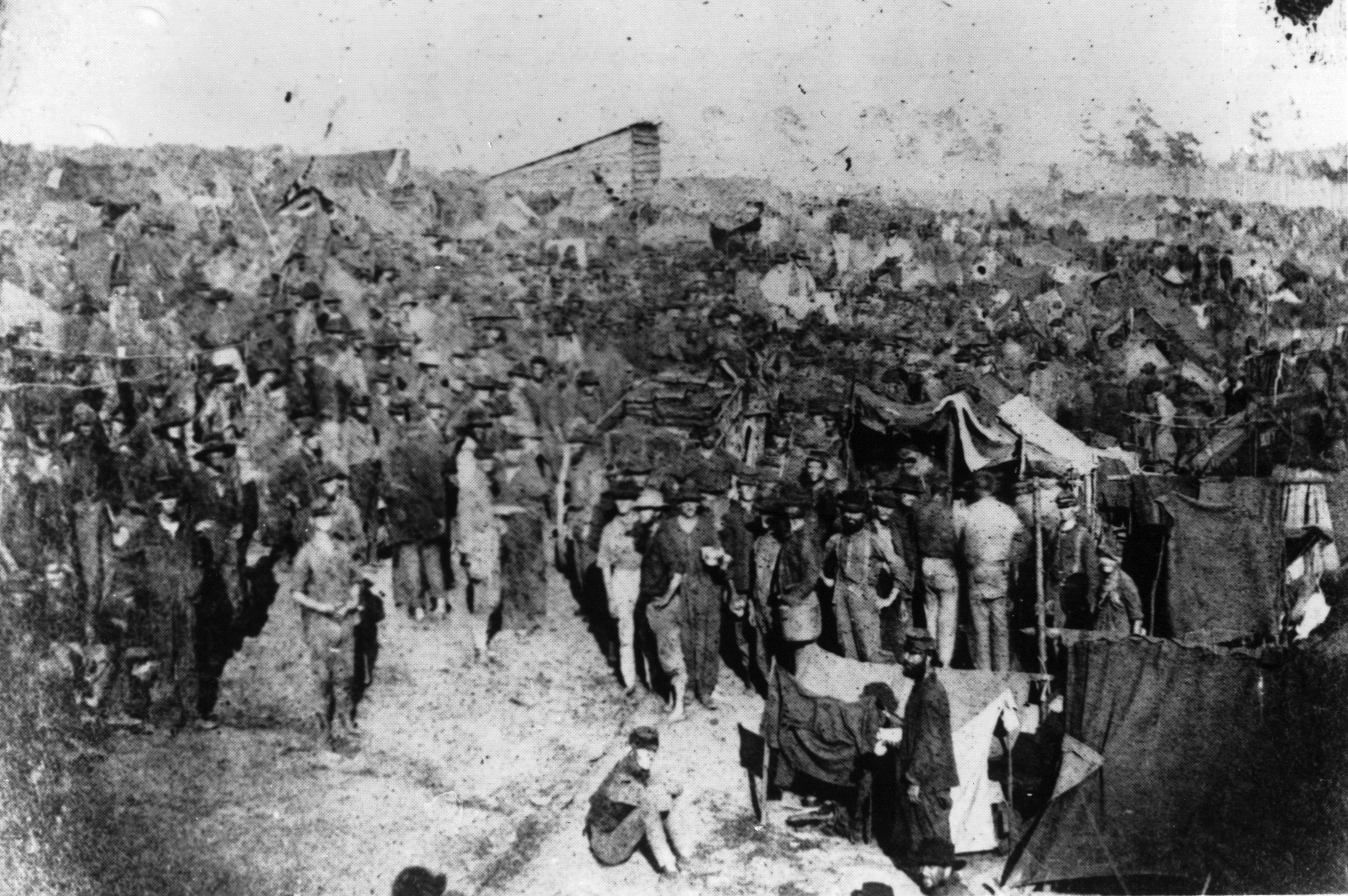
Photo of Andersonville
I have to admit that I'm really lucky to survive till this point. The hardships in military have not put off my passion to serve and fight. Nothing but death will stop me from fighting for my beliefs.
June 15, 1863
Since the Union passed the Militia Act, many blacks have joined the northern army. In a recent battle at Fort Wagner that I participated in, I encountered the soldiers from the 54th Massachusetts Regiment. It is a force of all black men, led by a white commander, Shaw. Surprisingly, the 54ths were very disciplined and organized. I have to admit that I was shocked by their outstanding courage -- every one of them fought very bravely till they fell onto the ground.

Soldiers from the 54th MA Regiment
Although I deny the blacks' rights as citizens or humans, I do think that they might make a good amount of contribution in the war if they are allowed in the military. Even if they don't actually fight in the war, they can still take over simple tasks such as cooking and delivering supplies, like many of the blacks in the northern army. When blacks are captured, people can just kill them and make room for others in prison camps.
Actually, I think it should be encouraged for enslaved blacks in the south to join the military, and free the ones who have fought for us. On one hand, we are great demand of soldiers to cover the loss from previous battles. On the other hand, many slaves are secretly helping the North by serving as spies or scouts. Since the Emanicipation Proclamation, many of them have abandoned their plantations to join the northern forces or rebel against the Confederacy. If we have slaves to fight for us and free them afterwards, they would not have a chance to serve the North, and they would stay loyal to us. We could have taken an upper hand in the war.
July 2, 1863
I was wounded in a battle last week -- a bullet scraped over my shoulder, and I broke my right leg. The injury wasn't too serious, but I was still quite terrified. I have seen so many people die in this war, but I have never felt it so close to myself before.
I was carried into a sanitation station, and a female nurse has been taking care of me. Her name is Rebecca, and she's about four years younger than me. She's sweet and caring, and has always made me smile. Rebecca is very patient and delightful, and I enjoy talking to her.
Today, she shared her experience as a nurse in the war with me. She has been a nurse for two years now. In 1861, she joined the American Red Cross founded by Clara Barton. According to Rebecca, the Red Cross is an organization that takes care of the wounded from both sides, and many women like her have joined to work as nurses. She enjoys working at the front, and is willing to take care of the southern soldiers like me even though she is originally from Maryland.

Red Cross Poster
Rebecca also told me that many women have taken over important professions since the war has started. Some have been in charge of the family businesses when their husbands are fighting at the front, and some others have joined their brothers or husbands in the military camps to help with chores, or serve as spies and guides. Rebecca's little sister is now working as a teacher in school.
I think these women are absolutely admirable to have taken over all these responsibilities that usually belong to men. Thanks to them, the wounded are taken care of, and the country still runs with so many people fighting in the war. The picture below, cut off from the Harper's Weekly, concludes my grateful thoughts to all the hardworking women in this war.
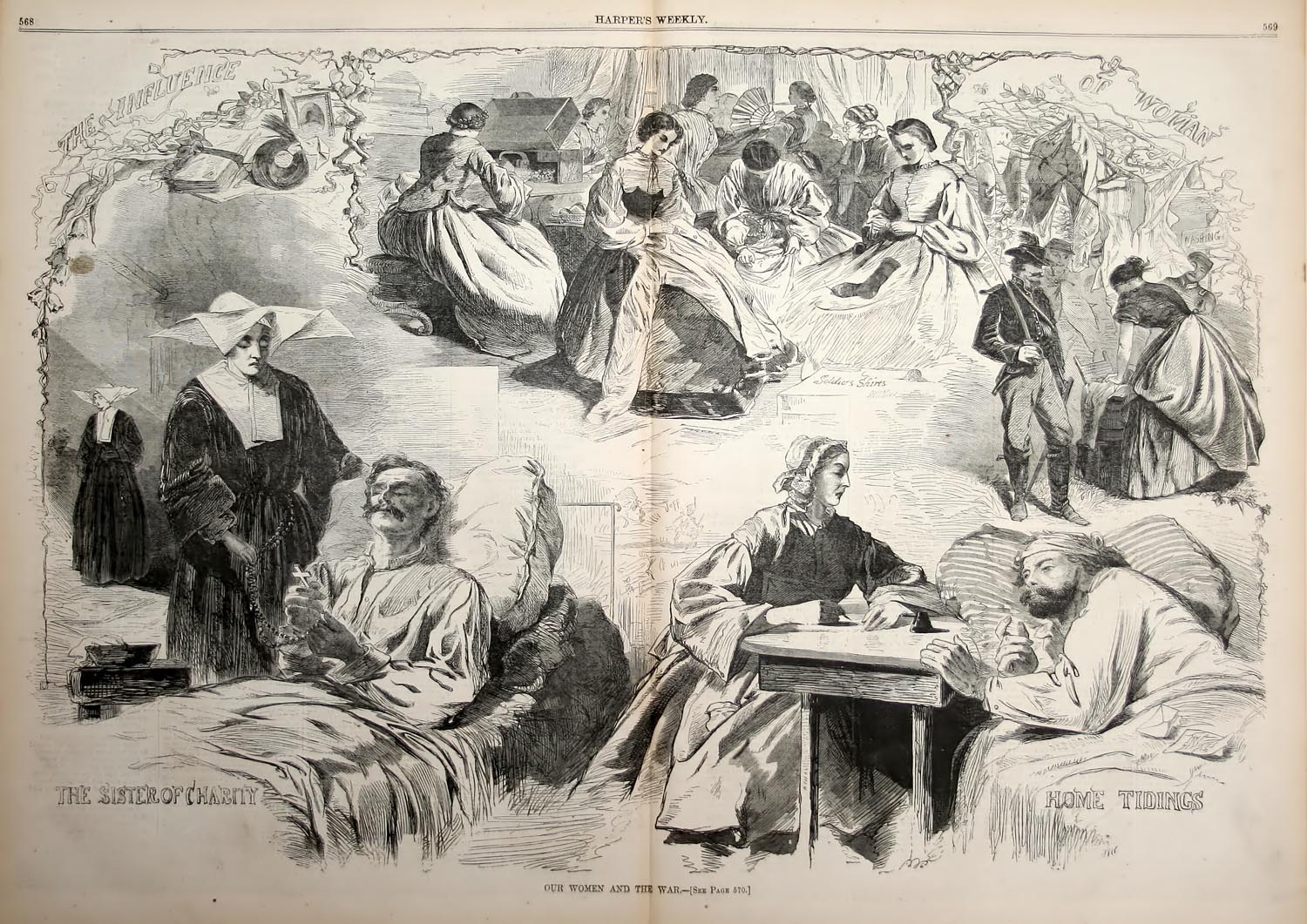
A Video about Women's Role in the War
July 20, 1863
The fourth week at the sanitation station -- I'm recovering, and will soon go back to the front. Probably tomorrow, or the day after. During these four weeks, I've become very close to the nurse, Rebecca. She takes good care of me, and we enjoy sharing our views on everything from two very different perspectives.
Today, we talked about life during wartime in both the North and the South. I told her that the Confederacy has been having a very hard time paying for the war, because the war has reduced the values of the southern crops, which is the main resource of money. Our president, Davis, tries to ease the economic hardship by seizing Union supplies and raising taxes. However, the southerners resisted the 10% tax on their farm products, and the Union blockade on water has made the situation even worse. Davis issued paper money, but the huge flow of paper money soon caused inflation.

Confederate 100 Dollars Bill
I also told her about the difficulty in building unity in the south. President Davis is losing support from the people, because the South isn't doing so well in the war. The parties against Davis are growing in size, and there's even voice calling for his impeachment. In response to these voices, Davis enacted conscription laws that allowed the military to seize private properties for war needs, and suspended habeas corpus in the constitution to penalize those who speak against the Confederate government. I expressed my hatred in acts like these. Davis isn't leading the South well enough as the president, and he even abuses people's civil rights to freely speak -- these laws are definitely unconstitutional, and not acceptable, even in wartimes.
Rebecca told me that Lincoln has done the same to the Union. He suspended habeas corpus, and allowed the military to arrest those who show disloyalty to the Union or criticize him. There has been a group called "Peace Democrats" rising against Lincoln's leadership. They demanded peace and called to end the war, sometimes through violent ways (which I think is very contradictory). The Union is also going through a hard time keeping unity, said Rebecca. Earlier this year, the Union government announced the conscription for troop demands. It stated that all white man between 20-45 in age might be called for military service at any time, unless they pay 300 dollars for a replacement.
"It is a cruel law," I said, "because all the poor working class don't really have a choice but to leave their families and join the war."
"It is." agreed Rebecca, "that's why the riot happened."
She was talking about the New York Draft Riot from July 13th to 16th. In New York, the poor white working men rebelled because they fear to lose their jobs to blacks after they are called in for war. I think they did the right thing -- if they don't do anything in response to the unfair government decisions, they will always be oppressed. But they targetted the wrong people. The blacks actually have no fault. Lincoln and the Union government should be the ones to blame. It's very unjust to scale people's lives on how much they earn. If the poor do not wish to fight, the government has no right to force them risk their lives.

New York Draft Riot

Paper Currency of the Union
In order to pay for the war, the Union also opened up the western lands for sale at a very low price through the Homestead Act of 1862. Selling land has always worked when the government is in need of money.
I told Rebecca that I think the North has better economic strategies than us, therefore they struggle less on collecting enough money to fill the war costs. They also have a better vision on constructing the nation. Their large railroad network has turned out to be a success, because it provides great help on transporting supplies to the front.
We also talked about our families. I told her, with great pride, that both my brother and me are serving as Confederate soldiers. And she said that her family is facing a division, like many of the other border state families. Her elder brother supports slavery, but her younger brother has joined the Union army to fight against it.
"Border states should have joined the Confederacy since the first place," I said, "so we can fight together and have a bigger chance of winning." She smiled, but did not reply.
We ended the afternoon in a friendly discussion, and then she had to leave for some more nursing work. I returned to my bed, read a newspaper, and did some packing for my departure. I was enjoying my time here too much, that I almost forgot there's still a war going on. Soon the fantasy is going to end, I said to myself. I would feel truly, truly empty after leaving Rebecca, because she is a perfect person to share my feelings to.
But late in the evening, Rebecca suddenly came to me, and started crying.
"I don't want you to leave!" she said while sobbing, "I think I love you... Aaron, can you stay with me please?"
I hugged her, and then kissed her. Everything happened in a second or two. I finally recognized my feelings to her.
"Me too, Rebecca. I love you. I love you so much. If I survive the war, I'll marry you." I said.
"You have to survive the war. Promise me."
"I will. I promise."
Bibliography
Confederate States of America $100 Note. N.d. Louisiana State University Special
Collections Hill Memorial Library. Web. 15 Feb. 2016.
<http://exhibitions.blogs.lib.lsu.edu/?page_id=707>.
Getty Images. Red Cross Recruiting Poster. 1917. PBS Newshour. Web. 15 Feb.
2016. <http://www.pbs.org/newshour/updates/
clara-barton-founding-american-red-cross/>.
Liu, Shako. Women's Role In The Civil War. YouTube. YouTube.com, 7 Dec. 2013.
Web. 15 Feb. 2016. <https://www.youtube.com/watch?v=Pck40xLO0qw>.
"New York Draft Riots." Harper's Weekly 1 Aug. 1863: n. pag. Wikipedia. Web. 15
Feb. 2016. <https://commons.wikimedia.org/wiki/
File:New_York_Draft_Riots_-_looting.jpg>.
"Our Women and the War." Harper's Weekly 1862: n. pag. Son of the South. Web. 15
Feb. 2016. <http://www.sonofthesouth.net/leefoundation/civil-war/1862/
september/civil-war-women.htm>.
Riddle, A. J. Andersonville Prison. Aug. 1864. National Park Service. Web. 15
Feb. 2016. <http://www.nps.gov/media/photo/
gallery.htm?id=A6A1C636-1DD8-B71C-07DB9DB39A2A1074>.
Soldiers from the 54th Massachusetts. N.d. New England Historical Society. Web.
15 Feb. 2016. <http://www.newenglandhistoricalsociety.com/
brutal-fanatic-founded-glorious-54th-massachusetts-regiment/>.
Steamship Colonel Lamb. 1864. U.S. Naval Historical Center Photograph.
Civilian Ships. Web. 15 Feb. 2016. <http://www.ibiblio.org/hyperwar/
OnlineLibrary/photos/sh-civil/civsh-c/col-lamb.htm>.
United States Currency 5 Dollar Legal Tender Note 1862. 1862. World Banknotes &
Coin Pictures. Web. 15 Feb. 2016. <http://www.worldbanknotescoins.com/
2014/10/1862-5-five-dollar-legal-tender-note.html>.

Good- much more detailed and analytical - this is what I was looking for! What are your thoughts on Lincoln suspending Habeas Corpus?
ReplyDeleteLincoln abused one of the fundamental human rights by suspending habeas corpus. Although it was beneficial to the Union during the special time period of warfares, it was still not acceptable. The freedom of speech was granted by the Constitution. Arresting people for speaking against the Union and himself was a disrespect of the basic human rights. People should have the freedom to express themselves at all times, because only in this way can their voice be heard by those in power.
Delete